The technical root
Spinor
A mathematical object with a distinctive transformation law under rotations. In spin-one-half quantum mechanics, its components describe amplitudes, not a little ball physically spinning.
02 / The connection
SpinorMind combines a precise scientific word with an expansive human one. The depth lies in their relationship: mathematical structure as a starting point for an intelligence-focused identity.
The technical root
A mathematical object with a distinctive transformation law under rotations. In spin-one-half quantum mechanics, its components describe amplitudes, not a little ball physically spinning.
The interpretive opening
Reasoning, inquiry, imagination and understanding. As a naming element, Mind brings a technical root closer to the purposes people might pursue with it.
The science / A useful distinction
In the spin-one-half representation, a 360° rotation changes the sign of the state vector; 720° restores it. A common sign change is a global phase, so it does not by itself change the isolated system’s measurement probabilities. The Feynman Lectures, chapter 6 develops this distinction.
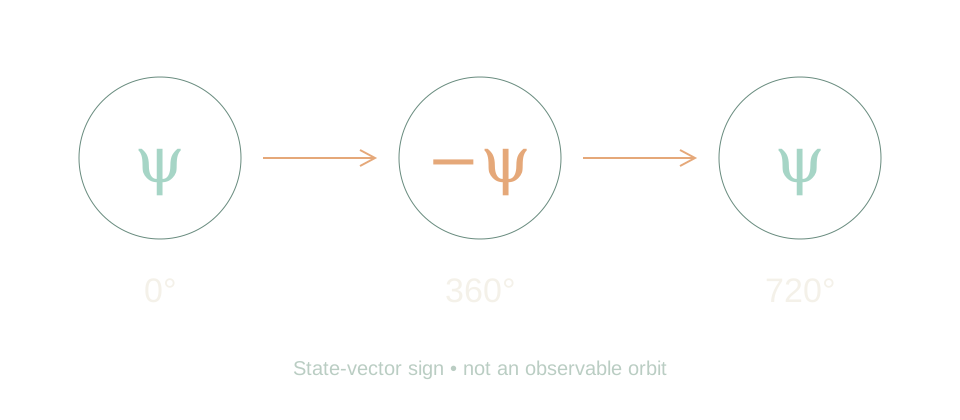
What the illustration does not say
The sign sequence is a mathematical explanation. It is not evidence that thought requires two turns, that cognition is quantum, or that an AI system uses spinors.
There is a related visual trap: the Bloch sphere represents a qubit state after global phase is removed. It therefore does not distinguish ψ from −ψ. IBM Quantum’s Bloch sphere lesson explains this representation. Our sign diagram deliberately uses labeled state vectors instead of presenting two different points on a sphere.
The naming interpretation
Spinor makes the name specific enough to reward curiosity. Mind makes it broad enough to point toward intelligence, research and discovery. The pairing suggests a company interested in the representations beneath a problem—and the tools that make them useful.
That is the creative connection. The name carries a scientific reference; the company would supply its own methods, evidence and achievements.
SpinorMind could sit above a scientific AI platform, a quantum software toolkit or a family of research products. Its ten letters contain no geography, launch year or single product format. That gives a founder room to define the organization before narrowing the product line.
The technical root also creates a useful trade-off: specialist audiences may recognize it; broader audiences may need a short explanation. A clear descriptor—such as “scientific AI tools” or “quantum software”—can make the offering immediately understandable.
Owning SpinorMind.com gives a buyer the exact matching web address for this identity. It does not confer scientific authority, trademark rights or rights over similar names. Suitability for a chosen market needs its own assessment.
Explore three possible directions →Scientific context reviewed September 18, 2026. Naming analysis and proposed uses are original interpretations. Referenced educators do not endorse this domain.